

 Facebook
 X
 Pinterest
 Copy Link
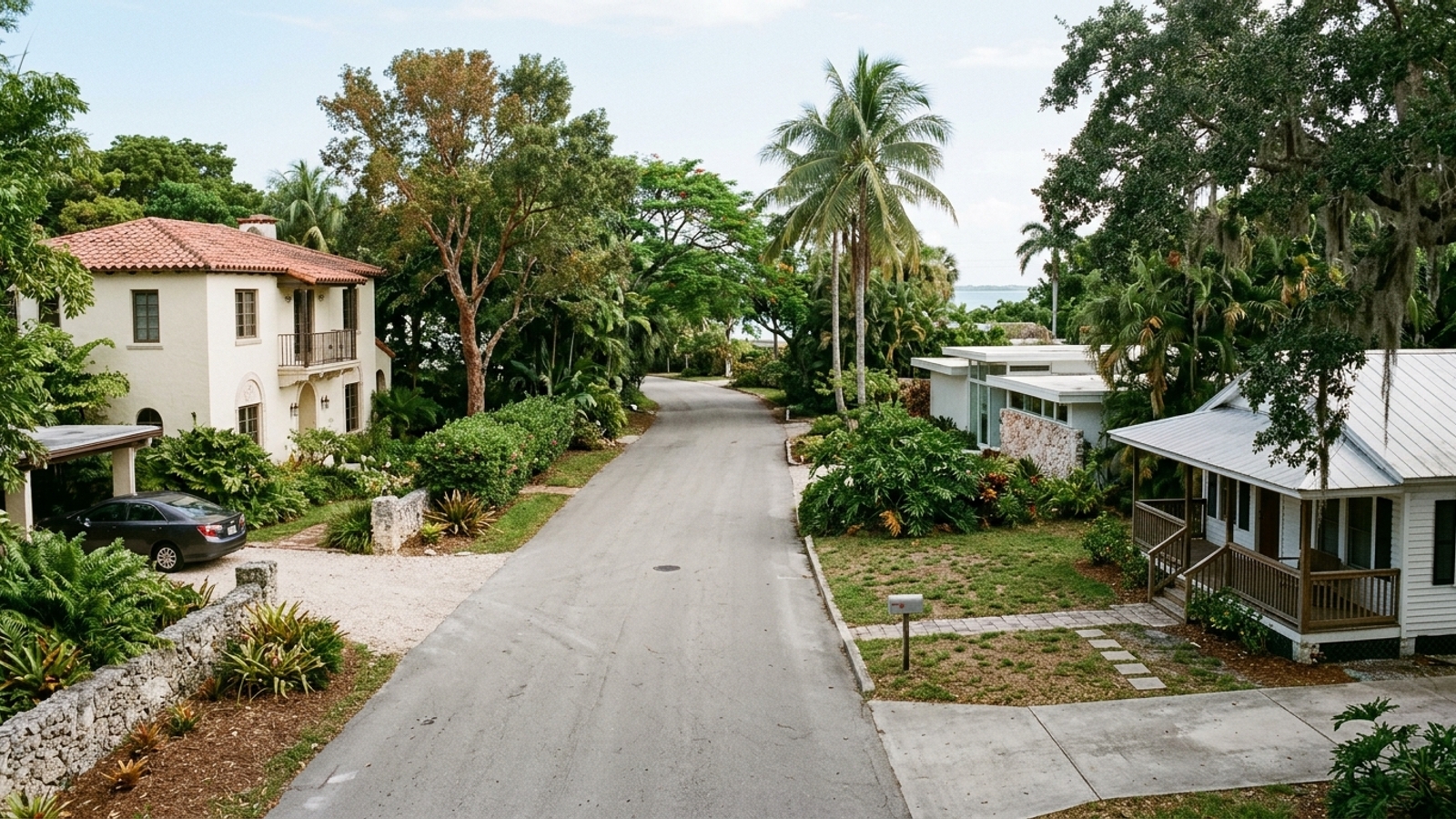
Coconut Grove is warm every month. NOAA’s 1991-2020 Climate Normals for the Miami area put average highs at 74°F in January and 88°F in July and August. Monthly precipitation runs from 2.3 inches in the winter months to 8.5 inches in September.
Key Takeaway
Coconut Grove is warm all year, so the weather pattern that matters when you buy is water: a wet season from roughly May to October, hurricane season from June through November, and fall king tides along the bay. If you are shopping now, condos give you the most room to negotiate, with condo prices down 1.5% year over year in the 90 days ending October 31, 2026. If you would rather control your own flood and storm prep, a single-family home on higher ground is the alternative.
Who This Guide Is For
You are weighing a move to Coconut Grove and want to know how heat, rain, hurricanes and flooding should shape when you buy and which home you choose.
What Are the Weather Patterns in Coconut Grove?
Miami’s climate is classified under the Köppen system as a tropical monsoon climate, with hot, humid summers and a distinct, drier winter season.
For the bigger picture, see Pros and Cons of Living in Coconut Grove Miami.
In the 90 days ending October 31, 2026, the peak of storm season, condos sat a median 143 days on market against 74 for single-family homes. That gap left room to negotiate for buyers who shopped through the storm months and ran the water checks others skip. One 90-day window cannot prove the season caused the gap, but it is the market you are buying in now.
Coconut Grove Weather by Season
The year breaks into three overlapping seasons rather than four calendar ones.
Dry Season From October to May
The dry season runs roughly from mid-October through mid-May, according to the National Weather Service. These are the mild, lower-humidity months. Buyers looking for local activities can review things to do in Coconut Grove.
The dry months show a street at its best, which is exactly the problem: a home toured only in the dry season hides how its street drains in a summer storm. Ask the seller for photos from the rainy months, or come back after a heavy afternoon rain before you go under contract.
Wet Season From May to October
The wet season begins around May 15 and ends October 15. It brings hot, humid days and short, heavy afternoon thunderstorms that often clear within an hour or two, with September the wettest month. Air conditioning runs most of the year, and roofs and drainage get tested daily.
The cost this season adds is electricity. Ask the seller for 12 months of electric bills rather than trying to estimate them.
Hurricane Season From June to November
The Atlantic hurricane season runs from June 1 to November 30. The National Hurricane Center states that most activity occurs between mid-August and mid-October, with the climatological peak around September 10.
A named storm in the forecast can stall a purchase. Insurers can pause new policies, so if a storm threatens while you are under contract, you may not be able to buy coverage until it passes. Get insurance quotes in the first days of your inspection period, not the last.
Flooding in Coconut Grove
Part of Coconut Grove sits on the Miami Rock Ridge, at roughly 13 feet above sea level, with isolated points reaching 20 to 23 feet. The bayfront sits much lower. Check which neighborhoods and districts sit on the ridge before you shortlist streets.
That elevation difference creates three distinct water problems, each with its own cause and its own check.
Summer Rain Flooding
Short, intense downpours can overwhelm street drainage and leave ponding for hours, even well away from the bay. Whether water pools in front of a house depends more on the street and the lot grade than on distance to the water. The City of Miami’s Citywide Stormwater Master Plan, approved in 2024, includes Coconut Grove on its priority-project map.
Flood maps won’t show you street ponding. Ask the seller directly whether water has reached the garage, driveway or interior, and request the seller’s flood disclosure form.
King Tides in the Fall
The highest predicted tides of the year, usually in the fall, can push bay water up through storm drains onto low streets on clear days, with no rain required. This flooding is predictable but recurring, and it can affect getting in and out of your street on those days. Visit the street at a predicted king-tide high before you commit to any property near the water.
Storm Surge Along Biscayne Bay
Hurricane surge is rare, but it is the most damaging event on this list. In 2017, Hurricane Irma pushed Biscayne Bay into the area. The National Weather Service’s Miami office surveyed peak inundation of slightly greater than 6 feet in isolated spots in Coconut Grove and Brickell.
Bay views come with the highest surge exposure and, in a high-risk zone with a mortgage, required flood insurance. Look up the address on FEMA’s Flood Map Service Center and ask for an elevation certificate before making an offer.
How Weather Affects Each Home Type in Coconut Grove
Your property type determines whether you manage storm preparation yourself or share the responsibility and costs with an association. When buying a home, prices by type differ, and so does who pays for the weather.
Single-Family Homes
With a detached house, you control the roof, shutters or impact glass, generator and lot grading, and you pay for all of it. The Florida Building Code’s High-Velocity Hurricane Zone provisions for Miami-Dade County require structures to withstand minimum wind velocities of 165 mph up to 195 mph depending on the risk category. As a result, older and newer houses insure very differently. The age of the house and its roof drive your premiums as much as distance to the water does.
Single-family homes had about a third of the condo market’s supply during peak storm season, 6.4 months, and ran a median $556 per square foot. Every storm upgrade and every insurance premium is yours alone. Ask for the wind mitigation report and the roof’s age before you price your offer.
Condos
Condos offered deep supply during storm season, with 18 months of inventory in the 90 days ending October 31, 2026. The building handles shutters and storm prep, which suits an owner who is away in the summer. Grove condos cost more per square foot than single-family homes, at a median $566, despite carrying a lower median price.
The hidden weather cost in condo ownership comes from state safety rules. Florida requires condominium associations to complete a structural integrity reserve study every 10 years for buildings three stories or higher. It also requires a phase-two milestone inspection if a phase-one inspection finds substantial structural deterioration. Storm-proofing an older building is a shared bill you inherit the moment you close. Ask the association for its latest milestone inspection, its reserve study and any planned special assessments before you sign.
Townhouses
Townhouses sit in the middle: you have your own walls and often your own storm prep, with an association handling shared elements. They were the one type where roughly one in ten sold above asking even at the peak of storm season, though that figure rests on just 42 sales. The median time on market was 61 days.
Responsibility for roofs, shutters and flood damage is split between you and the association. Ask exactly which storm-related items the association covers and which fall on you, in writing.
Best Time to Buy a Home in Coconut Grove
Shopping during the wet and hurricane seasons gives you a clearer view of a property’s drainage and, in certain segments, more room to negotiate. On a condo listed at $565,000, the 94.5% median condo sale-to-list ratio (90 days ending Oct 31, 2026) implies a closing near $533,900. That gap is the room storm-season shopping gives you, before any credit you negotiate for weather findings. Mitzi Mitchell can pull flood zone and elevation details on a listing you are considering.
Weather Checks Before You Make an Offer
Start with a flood map lookup and request an elevation certificate. Then ask for the seller’s flood disclosure form and whether the property has ever had a flood insurance claim. Request the wind mitigation report and verify the roof’s age. Get insurance quotes early in the inspection period. For condos, review the milestone inspection and reserve study. Visit the street after a heavy rain or at a king tide to see how the drainage performs.
Questions to Narrow Your Search
- Will you live in the home from June through November, or leave it empty during hurricane season? If it will sit empty, read the Hurricane Season and Condos sections, where the building handles shutters and storm prep. If you will be there and want control, read Single-Family Homes.
- Can you accept a FEMA flood zone in exchange for being near the bay? If yes, read the Storm Surge and King Tides sections for what that costs you in checks and coverage. If no, focus on the higher ground covered in Flooding in Coconut Grove.
- Are you ready to shop through the end of storm season, or would you rather wait for the dry months? Best Time to Buy a Home shows what the storm-season numbers mean for your offer.
- Do you want to handle storm prep yourself, or share it through an association whose reserves and assessments you will help pay for? Compare the Condos and Townhouses sections against Single-Family Homes.
If you want the most negotiating room while shopping through storm season, start with condos, which had the deepest supply and the longest time on market. If you want full control over your own flood and wind prep, start with single-family homes filtered by flood zone and elevation certificate. If you want more space for your money, single-family homes ran the lower price per square foot. If you want someone else to handle shutters and storm prep while you are away in summer, look at condos after reviewing the milestone inspection and reserve study.
Coconut Grove Housing Market at a Glance
- All homes: median sale price $664,538, up 3.8% year over year; 975 sales; median 109 days on market; 94.6% sale-to-list; 4.7% sold above list; 13.5 months of supply; median $539 per sq ft (Redfin, 90 days ending Oct 31, 2026)
- Single-family homes: median sale price $822,581, up 3.5% year over year; 303 sales; median 74 days on market; 94.9% sale-to-list; 9.8% sold above list; 6.4 months of supply; 629 listings; median $556 per sq ft (Redfin, 90 days ending Oct 31, 2026)
- Condos: median sale price $534,855, down 1.5% year over year; 550 sales; median 143 days on market; 94.5% sale-to-list; 1.1% sold above list; 18 months of supply; 3,224 listings; median $566 per sq ft (Redfin, 90 days ending Oct 31, 2026)
- Townhouses: median sale price $1,132,430, down 0.5% year over year; 42 sales; median 61 days on market; 95.4% sale-to-list; 9.9% sold above list; 8.3 months of supply; 112 listings; median $597 per sq ft (Redfin, 90 days ending Oct 31, 2026)
Housing market statistics and trends across the full year show whether these storm-season figures hold in the dry months.
Coconut Grove Weather and Living FAQs
What Is the Weather Like in Coconut Grove All Year Round?
Average lows range from 61°F in January to 78°F in July and August, alongside the highs and rainfall above. The normals come from the Miami Beach GHCN station, since the Grove has no official station of its own.
What Type of Climate Does Coconut Grove Have?
It has a tropical monsoon climate under the Köppen system, warm year-round with a distinct wet season and a drier winter.
Is Coconut Grove on the Beach?
Coconut Grove fronts Biscayne Bay, with marinas and bayfront parks, but it does not have an ocean beach. The nearest ocean beach is at Crandon Park on Key Biscayne, approximately 5.3 miles away as the crow flies, or about a 9-mile drive via the Rickenbacker Causeway.
Is Coconut Grove Part of Miami or Miami Beach?
Coconut Grove is a neighborhood of the City of Miami in Miami-Dade County, not Miami Beach. It incorporated as its own city in 1919 and was annexed into the City of Miami in 1925.
Do You Need Flood Insurance in Coconut Grove?
Federally backed mortgages require flood insurance in FEMA high-risk zones, so look up the address’s flood zone and get a flood quote early. This is not insurance advice.
Is Coconut Grove Safe?
Local reporting citing City of Miami Police Department data put overall crime in Coconut Grove down 33% year over year as of May 2025. Police Chief Manny Morales said crime fell 78% across all crimes and 88% for violent offenses from 2013 to 2025.
How Much Does a Home in Coconut Grove Cost?
The median sale price for all homes was $664,538, up 3.8% year over year (Redfin, 90 days ending Oct 31, 2026).
Is Coconut Grove a Good Place to Live?
The pros and cons of living in Coconut Grove come down to year-round warmth weighed against wet-season storms and flood exposure that varies by lot.
Sources
- Redfin: Data Center
- NOAA NCEI: U.S. Climate Normals
- National Weather Service: Rainy Season Outlook
- National Hurricane Center: Climatology
- TopoZone: Coconut Grove Elevation
- National Hurricane Center: Hurricane Irma Tropical Cyclone Report
- City of Miami: Stormwater Master Plan
- Florida Senate: SB 4-D Summary
- Florida Building Code: Chapter 16
- Coconut Grove Spotlight: Crime is Down Across Miami
- FIU: Coconut Grove Community Background Report
- Distance Cities: Coconut Grove to Key Biscayne



