

 Facebook
 X
X
 Pinterest
 Copy Link
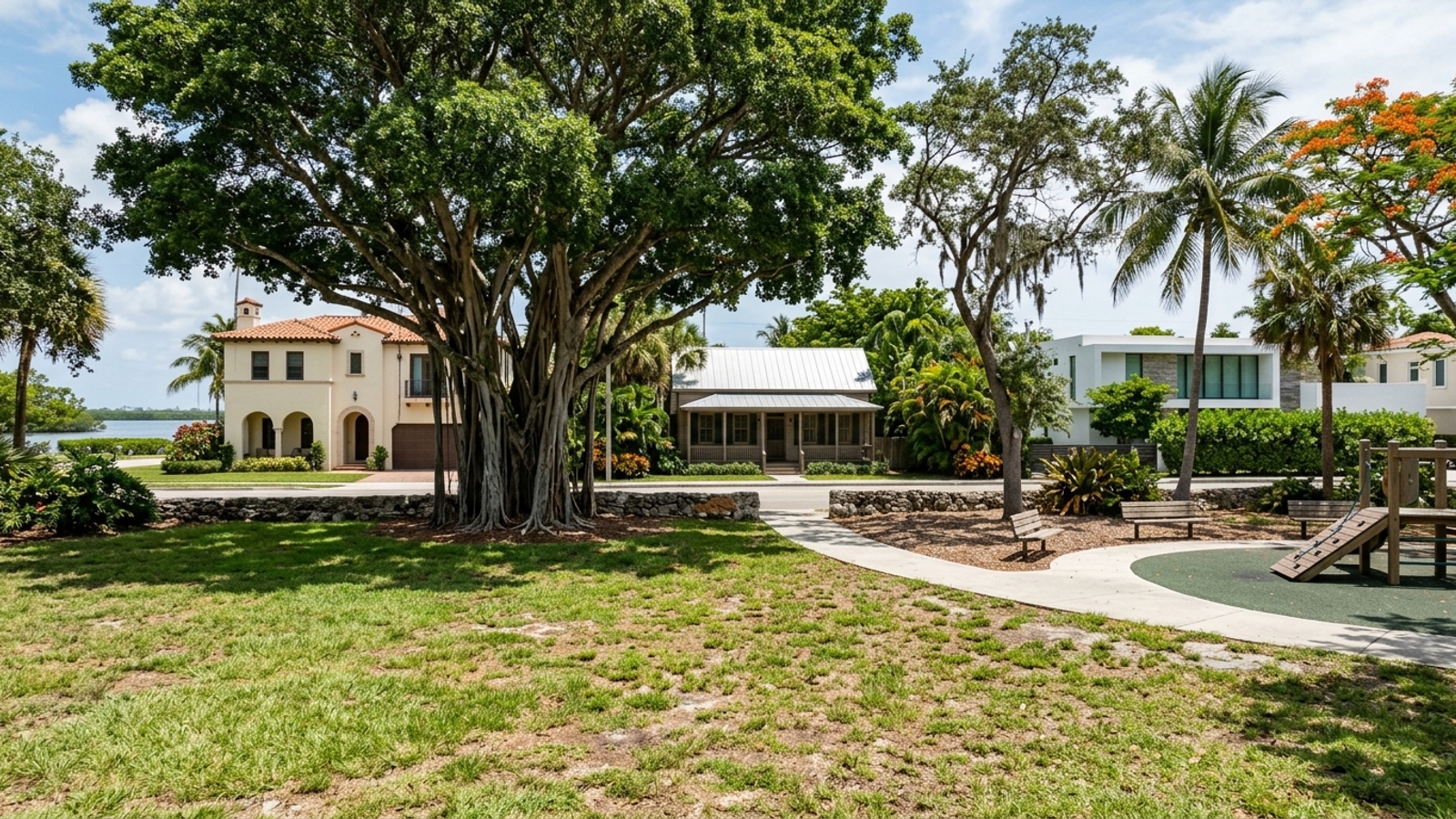
Coconut Grove sits about a 15-minute drive southwest of Downtown Miami, right on Biscayne Bay – and it operates as its own distinct world within the City of Miami. It’s entirely in Miami-Dade County, FL, and the housing stock reflects that layered history: historic estates, modern condos, gated subdivisions, and everything in between. Anyone buying a home in Coconut Grove, FL will find that this architectural variety offers options for almost any lifestyle.
The broader Miami market currently carries a median sale price of around $649,570, with homes spending roughly 116 days on the market. Coconut Grove is a different conversation. Overall median prices here hover around $2.5 million, making it a genuine luxury submarket. If you’re shopping here, understanding how the Grove is divided – and what each section costs – is where you have to start.
How Coconut Grove is Organized
The 2010 census recorded 20,076 people across 5.6 square miles. That’s not a big footprint, but the Grove is more internally varied than its size suggests. The recognized subdistricts are Center Grove, Northeast Coconut Grove, Southwest Coconut Grove, and West Grove – also called Black Grove. Locally, you’ll hear people compress that further into simply North Grove and South Grove. Main Highway and Grand Avenue are the central corridors running through it all.
Gated Enclaves and Subdivisions
Within those broader districts sit several notable gated enclaves: The Moorings, Camp Biscayne, and De Garmo Estates, along with Entrada Estates, Bay Heights, and The Cloisters. Private roads, detached single-family homes, and limited inventory are the common threads.
These communities sit at the higher end of an already high-priced market. Don’t expect to scroll through pages of listings – availability in any given enclave might come down to two or three properties at a time, if that.
Location and Transit Boundaries
Biscayne Bay forms the eastern boundary; LeJeune Road marks the west. US 1 – South Dixie Highway – is the main artery for anyone commuting north toward Downtown Miami or heading further south into the county.
The Coconut Grove Metrorail station, at the intersection of South Dixie Highway and West 27th Avenue, gives commuters a genuine alternative to sitting in traffic. It’s worth knowing about if daily driving is a concern.
Where Each Neighborhood Sits
The Grove’s layout follows two things: where the water is and where the commercial center lands. Center Grove is the hub, anchored by the CocoWalk retail and dining area. Everything else radiates out from there.
Northeast Coconut Grove pushes toward Downtown Miami and runs along the bay, so you get waterfront access combined with a shorter commute north. Southwest Coconut Grove stretches toward the southern city limits – quieter, more residential, less foot traffic. West Grove sits inland, closer to US 1 and the Metrorail station.
Waterfront and Island Sections
The eastern edge of the neighborhood borders Biscayne Bay directly. Along that stretch you’ll find Dinner Key, Peacock Park, Myers Park, and the local sailing club.
Just offshore to the northeast is Grove Isle – a 20-acre island with its own distinct inventory. It’s essentially all high-rise condominiums with direct water views. If that’s what you’re after, that’s where you look.
Home Types and Prices Across Coconut Grove
The wider Miami market carries about 10.4 months of housing supply, but Coconut Grove’s inventory is too segmented to summarize cleanly with one number. The range is genuinely wide.
Redfin recently reported Southwest Coconut Grove’s median sale price at $2.2 million – up 15% year over year. Northeast Coconut Grove came in at $2.3 million, up nearly 29% over the same period. Sailboat Bay offers a lower entry point, with medians closer to $649,500. Those three data points alone show you how much the subdistrict matters.
Detached Homes and Estates
Single-family homes are the dominant product in South Grove and in gated communities like Bay Heights and Entrada Estates. Larger lots, mature tree canopies, and historic architectural details are what you’re buying into. Pricing in these enclaves routinely exceeds the $2.5 million neighborhood median, and sellers across the wider Miami region are currently receiving about 94.8% of their list price – so don’t expect deep discounts on well-priced properties.
Condominiums and Attached Housing
Center Grove and the waterfront districts concentrate most of the attached housing. Grove Isle is exclusively condos. Center Grove mixes mid-rise buildings with modern townhomes near CocoWalk. The median there sits around $1,948,500. The trade-off you’re making is lot size and quiet for walkability and proximity to retail – a reasonable trade depending on what your day-to-day looks like.
Housing Market and Local Amenities
Any serious look at a home purchase has to include the infrastructure behind it – who’s providing services, who’s patrolling the streets, where your kids go to school. Coconut Grove falls under the City of Miami and Miami-Dade County for all public services.
For police coverage, the City of Miami Police Department handles the area. They assign a dedicated neighborhood commander to Coconut Grove and operate a local substation at 3727 Grand Ave.
County Level Services and Schools
The Miami-Dade Sheriff’s Office provides broader county-level law enforcement. The department is headquartered in Doral at the Fred Taylor Headquarters on NW 25th Street, currently led by Sheriff Rosie Cordero-Stutz. For street-level crime data on a specific address, the city and county portals are your best resource.
Public schools fall under Miami-Dade County Public Schools. Coconut Grove Elementary School, at 3351 Matilda St., is the local neighborhood elementary. School assignments are address-specific, so before you make an offer, pull the district’s boundary maps and confirm which school your prospective address feeds into. It’s an easy check that buyers sometimes skip.
Finding a Home in Coconut Grove
The wider Miami region recorded 1,170 homes sold in a single month against a total active inventory of 3,972 listings. Coconut Grove accounts for a small fraction of those available properties. You’re working with a limited pool.
If you have your eye on a specific gated community – The Moorings, Camp Biscayne – you should expect limited options and stretches where nothing is available at all. An agent who tracks off-market activity in these micro-neighborhoods is worth having.
Preparing Your Search
Prices run from around $649,500 in Sailboat Bay to well over $2.5 million in the Northeast and Southwest sections. That spread means your budget has to be fixed before you start touring, not after. Factor in property taxes and HOA fees for the gated enclaves – both can shift the monthly number meaningfully.
Touring in person also clarifies things that a map doesn’t. The energy around Center Grove’s CocoWalk corridor is genuinely different from the residential quiet of South Grove. Both are Coconut Grove; they don’t feel like it. Figure out which one you want to live in, then focus there.
Frequently Asked Questions
What neighborhoods and communities are in Coconut Grove, FL?
Coconut Grove includes recognized subdistricts – Center Grove, Northeast Coconut Grove, Southwest Coconut Grove, and West Grove. Locally, you’ll also hear North Grove and South Grove. Gated enclaves within those areas include The Moorings, Camp Biscayne, De Garmo Estates, Entrada Estates, Bay Heights, and The Cloisters.
What do homes cost across Coconut Grove’s neighborhoods?
The overall median is around $2.5 million. Northeast Coconut Grove sits at $2.3 million; Southwest Coconut Grove at $2.2 million. Sailboat Bay offers a lower entry point with a median closer to $649,500. Where you land within the Grove matters as much as the neighborhood name.
What school districts serve Coconut Grove’s neighborhoods?
Miami-Dade County Public Schools serves the area. The local neighborhood elementary is Coconut Grove Elementary School at 3351 Matilda St. Attendance zones are set by address, so verify your specific zone on the district’s website before you rely on assumptions.
How do I find homes for sale in a specific Coconut Grove neighborhood?
Local MLS portals and an agent who knows the Miami market are your two tools. In gated communities like The Cloisters or Bay Heights, inventory is thin enough that having someone monitor specific subdivisions for new listings – including off-market ones – makes a real difference.
What are the main differences between living in North, South, and Center Coconut Grove?
Center Grove is the commercial hub near CocoWalk, with condos and townhomes at a median around $1,948,500. North and South Grove are primarily residential – larger detached homes, historic estates, a quieter street-level experience. North Grove sits closer to Downtown Miami; South Grove extends further south along the bay.
Which Coconut Grove neighborhoods are located in high-risk flood zones or have strict historic tree canopy rules?
It depends on the specific street and elevation. Waterfront areas along Biscayne Bay and offshore communities like Grove Isle carry different flood zone designations than inland sections like West Grove. Consult Miami-Dade County’s official flood maps and municipal zoning codes for property-specific information on both flood exposure and tree canopy regulations.



