

 Facebook
 X
 Pinterest
 Copy Link
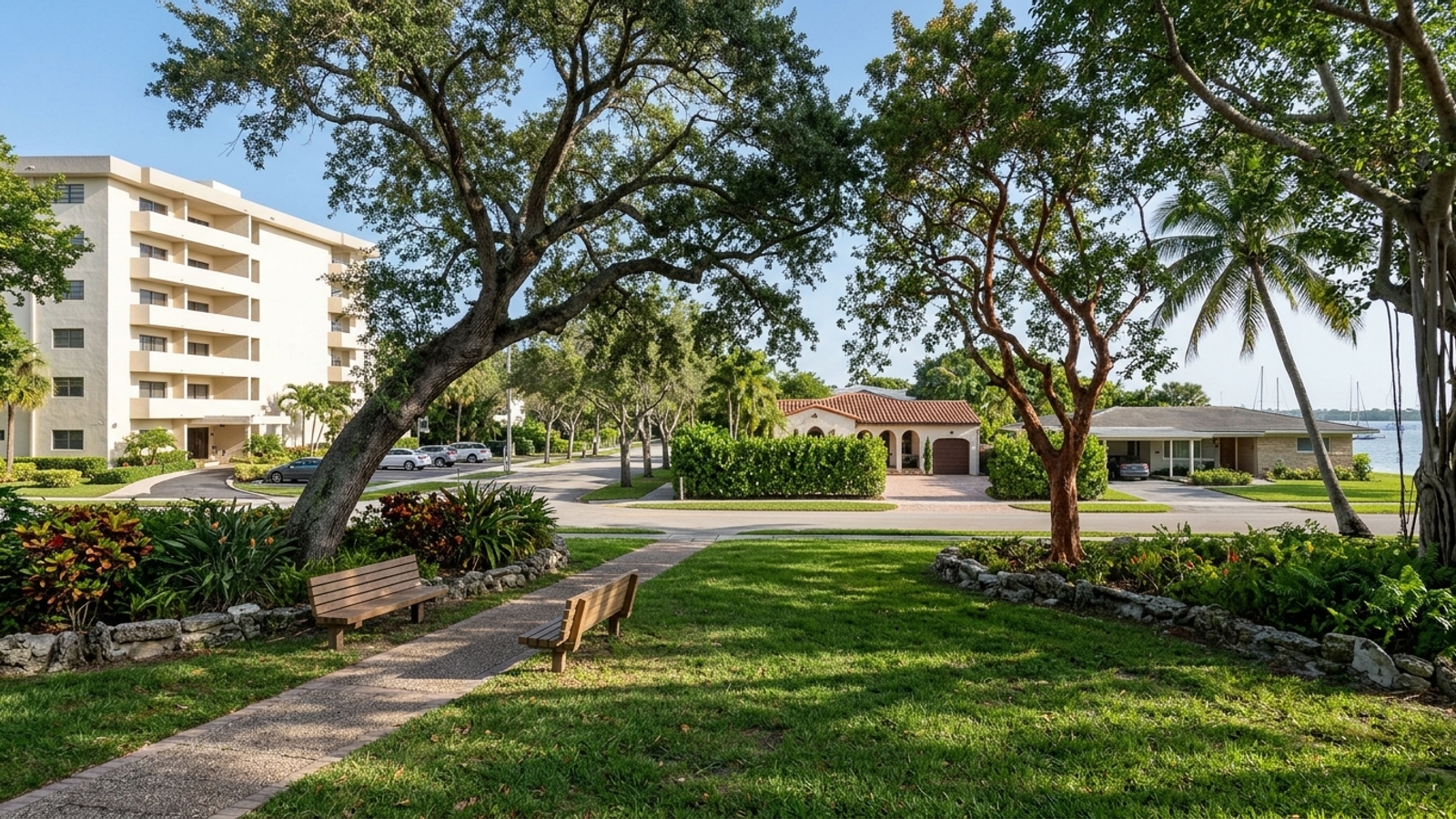
The Coconut Grove housing market has a quirk worth knowing before you start touring: the type of property you want shapes your price range, how fast you’ll need to move and how much negotiating power you’ll have at the table. The neighborhood sits on Biscayne Bay and runs the full spectrum from high-rise condominiums to detached houses with yards to townhomes, and each of those segments behaves differently right now.
Decide which one fits your budget and your life before you schedule a single showing. A condo buyer and a house buyer are operating in almost opposite negotiating environments.
Key Takeaway
If you’re moving to Coconut Grove and have flexibility on timing, start with condos. They’re the lower-priced entry point and the one segment where buyers hold real negotiating power, with 18 months of supply in the 90 days ending October 31, 2026. If you need a yard or more room, plan on a house or townhouse instead: the market moves faster, prices are firmer, and you’ll want financing sorted before you walk through the first door.
Who This Guide Is For
You’re planning a move to Coconut Grove and need to figure out whether a condo, a house, or a townhouse makes sense, and how quickly you’ll have to act once you start looking.
Which Home Type Fits a Move to Coconut Grove?
Pick your property type before you set your timeline, because the timelines are very different depending on what you want. Condos look like the affordable way in, and they are on a total-price basis, but they cost more per square foot than a single-family home: roughly $566 versus $556. What you get in exchange for that premium is time and negotiating room. The condo segment is sitting at 18 months of supply, with a median of 143 days on market and prices down 1.5% over the year. All figures cover the 90 days ending October 31, 2026.
For the bigger picture, see Pros and Cons of Living in Coconut Grove Miami.
Single-family homes are a different story. Six-point-four months of supply, 74 median days on market, prices up 3.5% over the same period. You get more space per dollar, and you compete in a tighter market for it.
Check the housing market page for full price trends across both segments over time. Once you know which property type you’re after, you can build a realistic search and negotiation strategy around it.
Coconut Grove Condos: Lower Entry Price, More Room to Negotiate
Condominiums make up the largest share of available inventory in the neighborhood. They carry the lowest entry price of any home type here, and listings are sitting long enough that you, not the seller, set the pace.
You have time to compare buildings, ask for concessions, and walk if the terms aren’t right. A seller who’s been listed for months is considerably more open to price reductions or closing-cost help than one who got three offers in a week.
There’s a layer of due diligence that comes with condo buying that doesn’t apply to detached houses, though. Florida now has binding rules about how associations fund long-term maintenance, and those rules have a direct effect on what you’ll pay every month as an owner.
Coconut Grove Condos
The median sale price for a condo is around $534,855. The typical unit took 143 days to sell, close to five months. That time on market is working in your favor right now, but it’ll work against you on the day you try to sell.
Plan to hold long enough to ride out what could be a slow listing period. The selling page lays out what that timeline looks like in practice. A slow market limits your exit options if circumstances change.
Florida Condo Inspection and Reserve Rules
Under Florida Statute 553.899, condominium buildings three or more stories tall must undergo a milestone structural inspection by December 31 of the year the building turns 30 years old, or 25 years if it’s within three miles of the coast, then every 10 years after that. Separately, Florida Statute 718.112 requires residential condo associations to complete a Structural Integrity Reserve Study at least every 10 years to ensure they’re holding funds for major structural repairs.
The building’s finances become your finances. Associations catching up on deferred repairs or reserve requirements can pass special assessments, and new owners aren’t exempt. Before you sign anything, ask the association for the latest milestone inspection report, the reserve study, current monthly dues, and any assessments that have been approved or are under discussion.
Renting While You Shop
With condo supply this deep, renting first costs you very little negotiating power. It gives you time to figure out which part of the Grove works for your commute and your routine before you’re locked into a purchase. Compare current asking rents across several listings yourself to gauge what a lease will run.
The limitation is that some condo associations restrict leasing, with minimum lease terms and approval requirements, which narrows which buildings you can rent in. Check the building’s rental rules with the association or the listing agent before you count on renting in, or eventually renting out, a unit.
Coconut Grove Houses and Townhouses: Faster Sales, Higher Prices
Buyers who want private outdoor space generally land on detached houses or townhomes. Both segments move in roughly half the time condos do, which means you need to be ready to act when a property you like hits the market.
Houses are where buyers sometimes pay over asking. A lowball approach that works fine in the condo segment can cost you a house outright. Get your financing and your decision-making ready before you start touring, not after.
Townhomes sit in the middle on space, but they come with their own pricing dynamics. The best-neighborhoods page has district-level prices across property types if you want to compare locations.
Single-Family Homes in Coconut Grove
The median sale price for a single-family home is roughly $822,581. Almost one in ten Coconut Grove houses sold for more than the asking price, which tells you something about where the competition sits relative to the condo market.
The tradeoffs are real: you’ll carry wind and flood insurance, and maintenance is on you. Get insurance quotes on the specific address and ask for an elevation certificate before you make an offer, not as an afterthought once you’re under contract.
Coconut Grove Townhouses
Townhouses make sense for a buyer who wants more room than a condo but isn’t looking for a detached lot. They carry a median sale price of approximately $1,132,430 and are the most expensive home type per square foot in Coconut Grove, at roughly $597, based on 42 townhouse sales.
Worth flagging: this is a thin market. A few outlier deals can move the median, and you’ll have far fewer options to choose from than in condos. Many townhouses also come with an association, so ask for dues and rules here just as you would with a condo.
What Living in Coconut Grove Is Like
Coconut Grove is a neighborhood of the City of Miami in Miami-Dade County, located on Biscayne Bay south of Brickell. It has a heavy tree canopy, a walkable village center with shops and restaurants, and a bayfront lined with parks and marinas.
The neighborhood is anchored by Dinner Key Marina, a City of Miami facility with 587 wet slips, and the adjacent 9.4-acre Peacock Park. Miami’s City Hall sits on the water at Dinner Key in a former Pan Am seaplane terminal.
The pros and cons page has a full breakdown of the cost of living and everyday amenities. The location puts the water close, but it also comes with specific municipal boundaries and transit realities you’ll want to understand before you buy.
Where Is Coconut Grove?
Per the City of Miami’s zoning code, the Coconut Grove Neighborhood Conservation District is generally bounded by Douglas Avenue on the west, Bird Road and Prospect Drive on the south, US 1 on the north, and Biscayne Bay and the Rickenbacker Causeway on the east. The primary ZIP code is 33133.
The ZIP code page has the exact boundary breakdown. One thing to know: the Grove isn’t its own city, so City of Miami taxes, permitting, and services apply, and the ZIP code doesn’t align exactly with the neighborhood boundaries.
What Is Coconut Grove Like Day to Day?
Daily life centers on the village center and the waterfront. Residents have access to marinas, bayfront green space like Peacock Park, and a dense stretch of local businesses.
The same village center that makes the Grove walkable also draws event and weekend crowds, which means traffic and parking pressure on nearby streets. Visit any street you’re seriously considering on a weekend night and during a festival before you make an offer.
Getting Around Coconut Grove
Coconut Grove is served by the Coconut Grove Metrorail Station on the western edge of the neighborhood and the Douglas Road Station just to the southwest. Freebee operates a free, fixed-route electric shuttle with 14 stops ranging from Monty’s to the Grand Avenue/Hibiscus Street intersection.
A condo near the village center or a station can meaningfully cut how much you drive. That said, many Grove homes are a long walk from both Metrorail and the village center, and the main roads in and out back up at rush hour. Drive your actual commute at peak time from any address you’re serious about.
Costs and Risks to Check Before You Move
Buying near the coast in South Florida requires specific due diligence. Flood risk, property taxes, and school assignments can vary block by block, and finding out late is expensive.
Don’t rely on a seller’s current bills or assume that neighborhood-wide figures apply to a specific address. Use official county and city resources to verify the facts for every property on your shortlist.
Confirming these costs upfront is also the only way to compare properties accurately. It’s the difference between knowing your total carrying cost and guessing at it.
Flood Zones and Insurance
Miami-Dade County provides an official interactive Flood Zone Maps tool to look up FEMA flood zone designations by address. You can also call the county’s Flood Zone Hotline at 305-372-6466 to confirm the details.
A lender may require flood coverage depending on the zone. Flood zone designation and insurance cost vary block by block, so ask the seller for an elevation certificate and any flood claim history, and get quotes from more than one insurer before you make an offer.
Property Taxes and Homestead Exemption
Property taxes in Coconut Grove are based on the City of Miami millage rate, as set by the Miami-Dade Property Appraiser. Florida offers a homestead exemption for primary residents, which can reduce the taxable value of the home.
The seller’s current tax bill is not a guide to yours: the assessment can reset after a sale. Estimate your own property tax bill using the Miami-Dade Property Appraiser with your expected purchase price.
Schools
School assignment depends on the exact address. Miami-Dade County Public Schools operates the public facilities serving the area, and boundaries can cut through the middle of a neighborhood. Assignments can change, and choice or magnet programs have their own application deadlines. Confirm the assigned public school for each address with the district’s school locator before you make an offer.
Safety Data
The City of Miami Police Department and the Florida Department of Law Enforcement provide official crime statistics. Use their reporting systems to look up incident types by specific location rather than relying on neighborhood-level figures, which may not match the Grove’s actual boundaries.
How to Narrow Your Coconut Grove Search
Across all home types, sales closed at 94.6% of the list price, so even the faster segments typically leave a little room to negotiate. To figure out where to start, work through a few questions. Do you need to own within a few months of arriving, or can you rent and shop? If you can wait, the condo and renting sections above are your starting point. If not, focus on single-family homes and be ready to move quickly. Do you need private outdoor space, which points to houses or townhouses, or is a balcony enough? Are you comfortable with an association, monthly dues, and the possibility of special assessments? Can your budget absorb flood and wind insurance on a specific coastal address?
If the lowest entry price and time to negotiate are what matter, start with Coconut Grove condos: they carry the lowest median of the three home types and by far the deepest supply. If you want a yard and a home in a rising segment, start with single-family homes and expect competition. If you want more space than a condo without a detached lot and can pay the premium, start with townhouses. If you want to learn the neighborhood before committing to a purchase, rent first, then shop condos. A local professional can help you weigh these options; see the choosing a buyer’s agent page for more, and review the buying process and prices by type page to plan your next steps.
At a Glance
- All homes (90 days ending 2026-10-31): median sale price $664,538 (up 3.8% year over year); 975 homes sold; 109 median days on market; 94.6% sale-to-list; 4.7% sold above list; 13.5 months of supply; 4,288 homes in inventory; $539 median price per sq ft
- Condo (90 days ending 2026-10-31): median sale price $534,855 (down 1.5% year over year); 550 sold; 143 median days on market; 94.5% sale-to-list; 1.1% sold above list; 18 months of supply; 3,224 in inventory; $566 median price per sq ft
- Single family (90 days ending 2026-10-31): median sale price $822,581 (up 3.5% year over year); 303 sold; 74 median days on market; 94.9% sale-to-list; 9.8% sold above list; 6.4 months of supply; 629 in inventory; $556 median price per sq ft
- Townhouse (90 days ending 2026-10-31): median sale price $1,132,430 (down 0.5% year over year); 42 sold; 61 median days on market; 95.4% sale-to-list; 9.9% sold above list; 8.3 months of supply; 112 in inventory; $597 median price per sq ft
Moving to Coconut Grove FAQs
Is Coconut Grove, Miami on the Beach?
No, Coconut Grove sits on Biscayne Bay, with marinas and bayfront parks, not an ocean beach. The nearest public swimming beach is Matheson Hammock Park in Coral Gables, which features a man-made atoll beach on the bay and is a short drive away. Crandon Park Beach on Key Biscayne is another nearby option.
How Far Is Coral Gables From Coconut Grove?
The two communities border each other, with Coral Gables located just to the south and west of the Grove. Drive times between the Grove’s village center and downtown Coral Gables are typically short, though exact times depend on traffic and your starting point. Check a map for the exact distance from your specific address.
What Is There to Do in Coconut Grove, Florida?
You can visit The Barnacle Historic State Park, where the grounds are open Thursday through Monday with a $2 admission, and house tours run at scheduled times for an additional fee. Vizcaya Museum and Gardens is open daily except Tuesdays with a $25 adult admission. In winter, the neighborhood hosts the Annual Coconut Grove Arts Festival, scheduled for February 13-15, 2027, at Regatta Park and Dinner Key Marina.
Is Coral Gables or Coconut Grove Nicer to Live In?
It depends on what you need. Coral Gables is a separate city with its own services and a municipal millage rate of 5.5590 mills for FY 2026, which you should compare against the property tax rates in the City of Miami. Review the daily-life section above for the Grove’s character, then compare the Coral Gables tax rate against the Coconut Grove market figures in the at-a-glance section to see which fits your budget.
Is Coconut Grove, Miami a Good Place to Live?
It suits movers who want a walkable, bayfront neighborhood and can manage flood and insurance costs. The all-homes median sale price is roughly $664,538, up 3.8% year over year, reflecting steady demand. The pros and cons page has a full list of everyday benefits and trade-offs.
What Is the Nicest Part of Coconut Grove?
The right area depends on your priorities: near the village center if walkability matters most, near the bay if water access does, farther out if you want a larger lot. The best-neighborhoods page has prices by district. Visit your shortlisted streets at different times of day to see how traffic and noise shift.
Is Coconut Grove Expensive?
The all-homes median price per square foot is roughly $539, meaning a 1,000-square-foot home at that rate is about $539,000. Condos run above this per square foot, so you’ll pay a premium for smaller spaces. The pros and cons page has a breakdown of everyday costs.
How Far Is Coconut Grove From Miami International Airport?
Coconut Grove is about seven miles from Miami International Airport. The drive usually takes around 15 to 20 minutes, depending on traffic. You can also use the Metrorail station in the Grove to connect to the airport transit system.
Sources
- Redfin: Data Center
- City of Miami: Miami 21 Zoning Code NCD-3
- Visit Florida: Coconut Grove
- Wikipedia: Matheson Hammock Park
- Wikipedia: Coconut Grove station
- City of Miami: Dinner Key Marina
- Miami-Dade County: Flood Zone Maps
- Florida Senate: Statutes 718.112
- Coconut Grove Arts Festival: Artist FAQ
- The Barnacle Historic State Park: Visit
- Vizcaya Museum and Gardens: Planning Your Visit
- Miami-Dade Property Appraiser: 2026 Proposed Millage Rate Comparison



