

 Facebook
 X
 Pinterest
 Copy Link
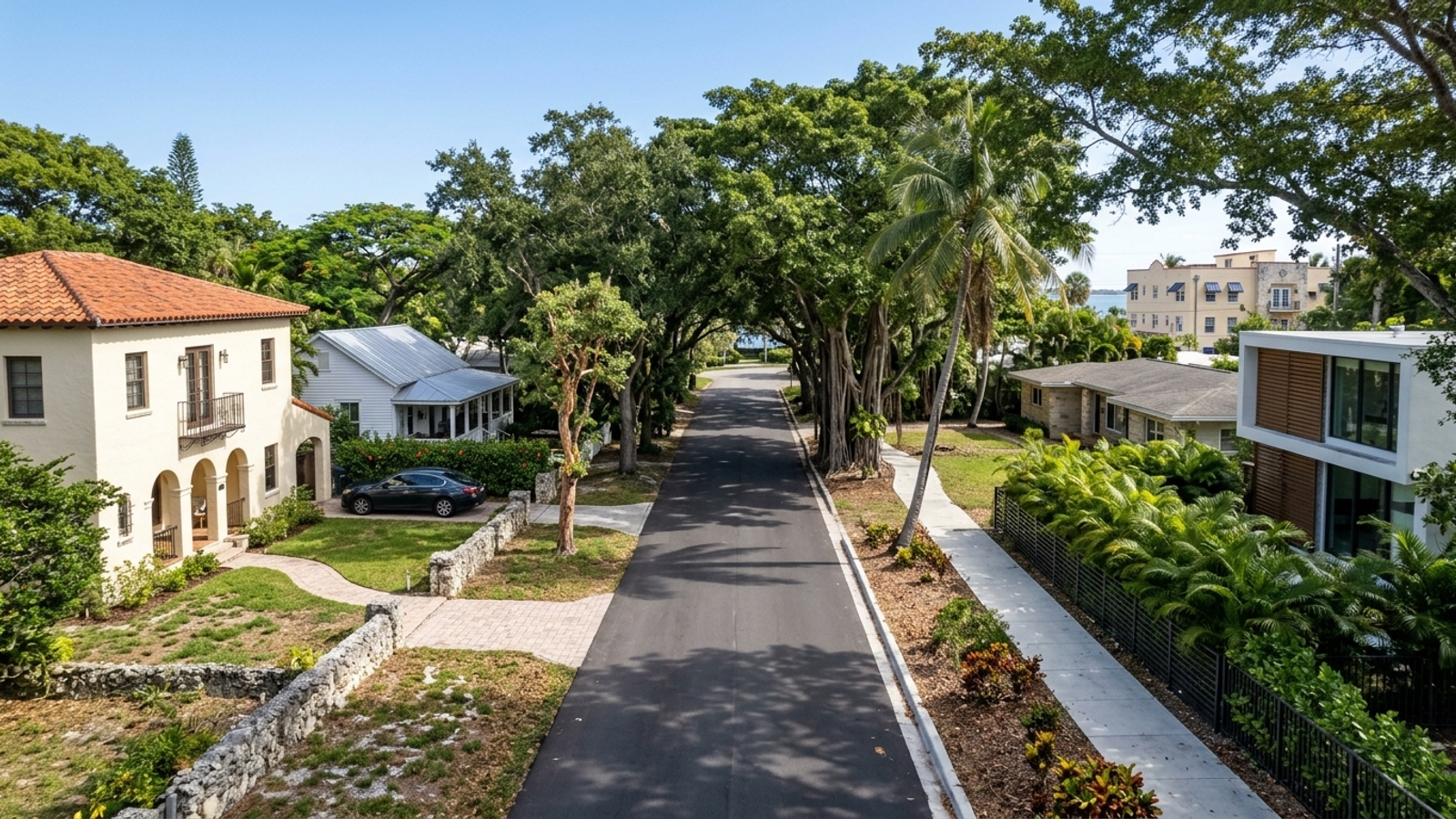
Coconut Grove sits along Biscayne Bay with a split personality: dense, walkable village streets on one hand, and quiet, canopy-covered residential roads on the other. How you move through this neighborhood shapes what you should buy and what you’ll pay for it.
Buyers chasing a car-light lifestyle tend to cluster around the village center and the transit corridors. Those who want larger lots and garages head further out. Review the pros and cons of living in Coconut Grove to see how that trade-off fits the broader picture.
Key Takeaway
Living car-light in Coconut Grove works best within walking distance of the village center or a Metrorail station, which for most budgets means a condo. Condos are where sellers have the least room to maneuver right now, taking a median 143 days to sell. If you want a yard and don’t mind driving, a single-family house is the alternative, though you’ll pay more and compete harder to get one.
Who This Guide Is For
You’re weighing a move to Coconut Grove and deciding whether to buy somewhere you can walk and ride the train, or a property where you’ll drive for nearly everything.
Do You Need a Car in Coconut Grove?
If you want to live here without depending on a car, you should be shopping for condos within a short walk of the village center or a Metrorail station. That’s also the softest part of the market right now: condos are sitting at 18 months of supply based on the 90 days ending October 31, 2026.
Car-dependent single-family houses are a different story, with 6.4 months of supply and a notably higher share selling above list price. The home type that suits car-light living is the one where sellers have fewer options, which gives you considerably more room to negotiate.
Getting Around Coconut Grove Without a Car
Piecing together transit, walking, and biking requires living near the commercial core or the main transit corridors. Residents who go car-free combine several modes to handle daily errands and commuting, and the system works reasonably well if your address cooperates.
Walking the Village Center
The walkable core centers around CocoWalk, Grand Avenue, and Main Highway, extending toward Peacock Park and the bayfront near Dinner Key. Running errands on foot works well inside that immediate area.
Step outside it, and sidewalks and shade become uneven fast. Summer heat changes how far anyone is willing to walk, so you should do the actual midday walk from any listing you’re serious about to the center before you count on it as a daily routine. Read about the weather patterns in Coconut Grove for more details on local conditions.
Metrorail and Metrobus
The Coconut Grove and Douglas Road Metrorail stations run along US-1, and the Orange Line gives you a one-seat ride north to Brickell, downtown Miami, and Miami International Airport. Metrobus routes feed into the stations, and a free local trolley also circulates through the area.
The Coconut Grove station is about one mile from the village center, roughly a 20-minute walk. Because both stations sit inland along the highway rather than on the bayfront, a lot of addresses involve a long hike to the platform. Map the exact walking distance from any home you’re considering before you assume transit is practical.
Freebee and Rideshare
Freebee runs an on-demand electric shuttle for short trips within the neighborhood. It operates Sunday through Thursday from 10:00 a.m. to 10:00 p.m., and Friday through Saturday from 10:00 a.m. to midnight. Uber and Lyft fill the gaps for trips outside the immediate area or after hours.
Freebee only runs inside a fixed service zone. Check that a home falls within its boundaries before treating the shuttle as a permanent car substitute.
Biking the Commodore Trail
The Commodore Trail is a five-mile paved path running through the neighborhood along South Bayshore Drive, McFarlane Avenue, Main Highway, and Douglas Road. It’s a solid option for local errands and the ride north toward Brickell. Stretches of the trail share space with vehicle traffic and pedestrians, so it’s not a fully separated path end to end.
If you plan to rely on a bicycle, ask the condo association whether the building allows bike storage in units or provides a secure bike room on the ground floor. It’s a small detail that matters a lot day to day.
Driving and Parking in Coconut Grove
Most residents rely on a personal vehicle, particularly those on the quiet, tree-lined streets further from the commercial center. Driving here means learning the main arteries and budgeting for parking when you want to spend time in the village core.
Main Routes In and Out
US-1 is the primary spine carrying traffic north toward I-95 and downtown Miami. South Bayshore Drive offers a more scenic route toward Brickell, while Main Highway connects south into Coral Gables. The Rickenbacker Causeway is the gateway across the water to Key Biscayne.
To see exactly where the 33133 boundary runs across these routes, review the local zip code guide. US-1 handles the bulk of outbound traffic, and rush-hour timing swings widely. Drive your actual commute at peak hour before making an offer. Low-lying streets near the bay can also flood during heavy rains, which is worth factoring into how you evaluate a specific address.
Parking in the Village Center
The Miami Parking Authority manages public garages and metered street parking throughout the commercial core. The municipal off-street Lot 1 near US-1 and Southwest 27th Avenue charges $2.50 per hour or $50 per month, and city agreements require certain private garages to match the prevailing public metered rates.
Weekend nights and event days fill the central spaces regularly. A car-dependent household will often end up paying for parking just to have dinner in their own neighborhood, which is worth pricing into the lifestyle before you commit.
Commuting From Coconut Grove
Where your office is and how close your front door sits to US-1 will determine almost everything about your daily commute. For residents heading north, comparing the train to the highway is a routine calculation.
To Brickell and Downtown Miami
Commuters heading to Brickell and downtown Miami can take the Metrorail, drive up South Bayshore Drive, or ride a bicycle along the bay. The right answer depends on how close your home is to the station. The train only saves time if both ends of your trip are a short walk from the platform; otherwise, you’re just adding a drive or a rideshare to your rail commute.
To Miami International Airport
The Orange Line offers a direct ride to Miami International Airport without dealing with highway traffic. Driving takes roughly 13 to 17 minutes depending on the route and time of day. Rail makes the most sense if you live near a station and travel light. Early morning flights or heavy luggage usually mean taking a car.
How Getting Around Affects What You Buy in Coconut Grove
Your transportation preferences will narrow your property choices more than you might expect. Review the Coconut Grove housing market data to see how prices and competition shift depending on the home type you’re targeting.
Condos
Condominiums are the most practical car-light option for most budgets. The median sale price for a condo is $534,855, down 1.5% year over year based on the 90 days ending October 31, 2026. That price dip combined with high inventory gives you room to push on the final number, the closing date, or seller concessions.
You can narrow your search by filtering listings for walk time to a station or the village center. The flip side is that the same slack market helping you buy will eventually slow your resale. Parking rights also vary by building, so you’ll want to ask how many spaces convey with the unit, what an extra space costs, and whether homeowner dues include parking.
Single-Family Homes
Single-family homes give you a private yard, a garage, and access to quiet streets. The median sale price for a house is $822,581, and this segment is considerably tighter than the condo market. What you give up is walkability: you’ll need a car for most trips, and you’ll have far less room to bargain with sellers.
Townhouses
Townhouses split the difference, offering more interior room than a typical condo with less exterior upkeep than a single-family house. The median sale price sits at $1,132,430, with a median of $597 per square foot based on 42 recent sales.
That figure is the highest of any home type in the neighborhood. And because there are relatively few sales in this category, those median figures can swing quickly from month to month. Factor this in when you’re comparing townhouse values over time.
Which Coconut Grove Home Fits How You Get Around?
The right property comes down to your daily routine.
- Do you commute to Brickell, downtown, or the airport most days? Review the transit and commuting sections above, then screen listings by walk time to a station.
- Could your household get by with one car or none? Focus on the condo market and ask buildings about their parking fees and guest spaces.
- Do you need a yard, a garage, or room for a boat trailer? You’ll be looking at single-family homes and accepting that you’ll drive for your errands.
- How much negotiating room do you want? Compare the days on market between condos and houses before you set your offer strategy.
To weigh your options across different parts of the area, compare the local neighborhoods. If you want to screen active listings by their exact walk time to the Metrorail, I can help you narrow your search.
At a Glance
- All homes, median sale price: $664,538, up 3.8% year over year (90 days ending 2026-10-31)
- All homes, homes sold: 975; median days on market: 109; months of supply: 13.5 (90 days ending 2026-10-31)
- All homes, sale-to-list: 94.6%; median price per sq ft: $539 (90 days ending 2026-10-31)
- Condos, median sale price: $534,855, down 1.5% year over year; median price per sq ft: $566 (90 days ending 2026-10-31)
- Condos, median days on market: 143; months of supply: 18; sold above list: 1.1%; sale-to-list: 94.5% (550 sales, 90 days ending 2026-10-31)
- Single-family homes, median sale price: $822,581, up 3.5% year over year; median price per sq ft: $556 (90 days ending 2026-10-31)
- Single-family homes, median days on market: 74; months of supply: 6.4; sold above list: 9.8%; sale-to-list: 94.9% (303 sales, 90 days ending 2026-10-31)
- Townhouses, median sale price: $1,132,430, down 0.5% year over year; median price per sq ft: $597 (90 days ending 2026-10-31)
- Townhouses, median days on market: 61; months of supply: 8.3; sold above list: 9.9%; sale-to-list: 95.4% (42 sales, 90 days ending 2026-10-31)
Getting Around Coconut Grove FAQs
Does Coconut Grove Have a Beach?
No. Coconut Grove sits on Biscayne Bay, which has bayfront parks and marinas rather than an ocean swimming beach. The nearest beaches are on Key Biscayne across the Rickenbacker Causeway.
Is There a Free Trolley in Coconut Grove?
Yes. The City of Miami operates a free trolley route through Coconut Grove. It runs Monday through Saturday from 6:30 a.m. to 11:00 p.m., with no Sunday service, though you should confirm current operating hours on the city’s website.
Is Coconut Grove Expensive?
It depends on what you’re buying. The median sale price for all homes in the neighborhood is $664,538, up 3.8% year over year based on the 90 days ending October 31, 2026. Condominiums generally price below that median, while single-family houses price above it.
Is Coconut Grove in Miami Beach?
No. Coconut Grove is a mainland neighborhood within the City of Miami along Biscayne Bay, while Miami Beach is a separate city on a barrier island. The drive between the two is approximately 11.8 miles and takes roughly 22 to 23 minutes by car.
How Far Is Coconut Grove From Downtown Miami?
The driving distance to downtown Miami is approximately 6.6 to 6.8 miles, which takes roughly 11 minutes by car. Commuters generally drive north via US-1 or South Bayshore Drive. You can also bypass the roads entirely by taking the Metrorail north from the local stations.
How Much Does Metrorail or the Bus Cost in Coconut Grove?
As of 2026, the standard fare for Miami-Dade Transit Metrobus and Metrorail is $2.25. Riders can pay using a transit card or a mobile app. The City of Miami trolley that runs through the neighborhood is completely free.
Does Coconut Grove Flood?
Yes. Low-lying streets near the bay can flood during heavy rain and seasonal king tides, which affects local driving and parking. Coastal areas of the neighborhood fall into FEMA’s high-risk AE and VE flood zones, and whether you need flood insurance depends on the property’s specific zone. Look up the FEMA flood zone for any home you’re considering and ask the seller whether the street floods during high tides.
Is Coconut Grove Part of Miami-Dade County?
Yes. Coconut Grove is a neighborhood within the City of Miami and Miami-Dade County, having been annexed by the city in 1925. It receives both county transit services like the Metrorail and city services like the free trolley. You can view the exact neighborhood boundaries in the local zip code guide.
Sources
- Redfin: Data Center
- Wikipedia: Coconut Grove station
- Greater Miami Convention & Visitors Bureau: How to Get to Coconut Grove
- Miami-Dade County: Transit Fares
- City of Miami: Trolley Information
- Freebee: Coconut Grove Route
- CBS News: 10 Scenic Bike Routes
- City of Miami Code of Ordinances: Off-street Parking
- Closest Airport To: Coconut Grove
- Rome2Rio: Coconut Grove to Downtown Miami
- Rome2Rio: Coconut Grove to Miami Beach
- Miami-Dade County: Flood Maps



