

 Facebook
 X
 Pinterest
 Copy Link
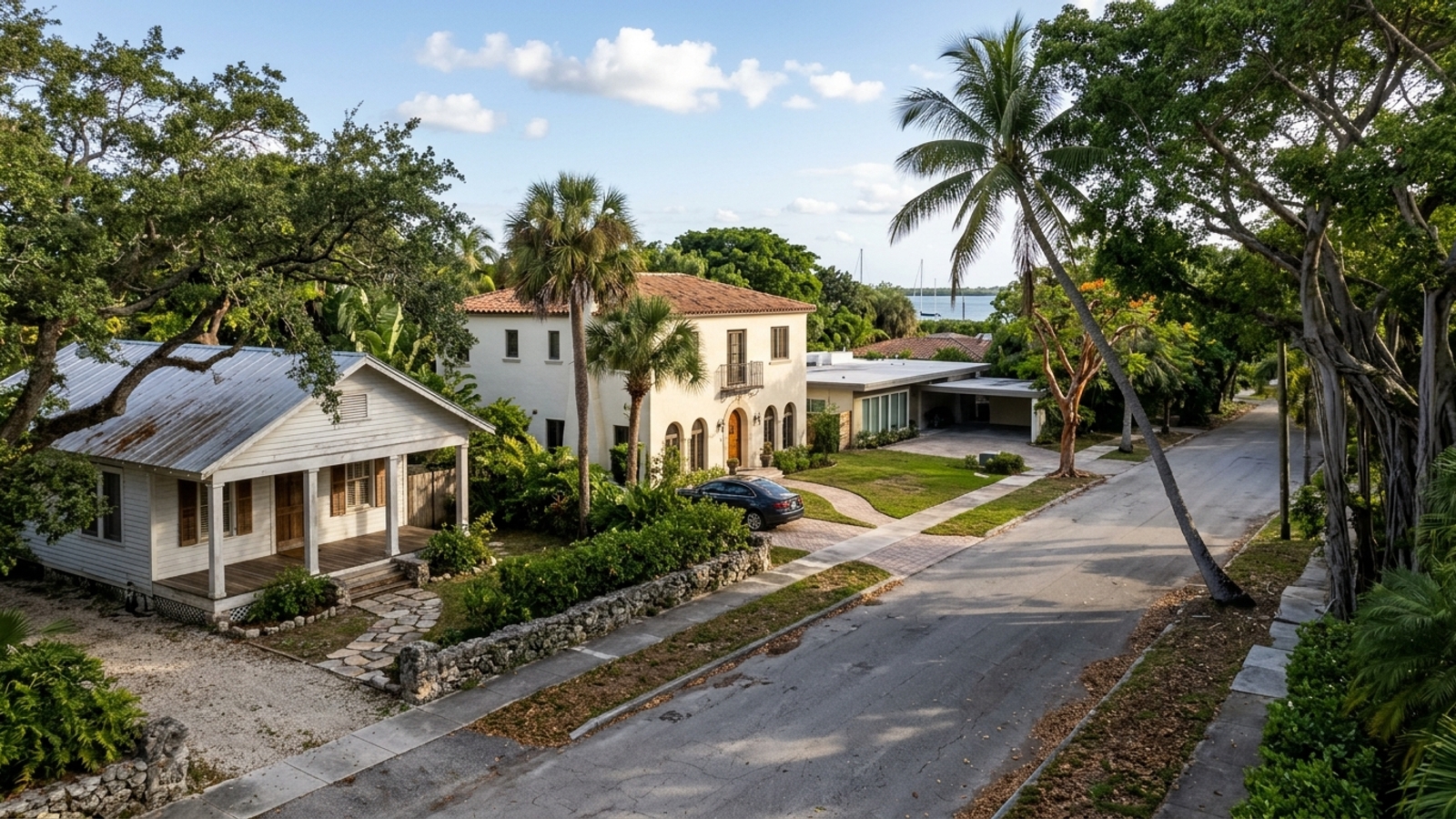
Coconut Grove is a bayfront neighborhood in the City of Miami, known for its marinas and tree-canopied streets. Buyers ask about local crime statistics often, but the area doesn’t have an independent crime rate separate from the city, so the real property checks happen at the individual address level.
The questions you can settle before closing come down to water exposure and building condition. With the latest market data showing shifts in how fast different property types sell, you’ll have more or less time to run those checks depending on what you’re buying.
Key Takeaway
Coconut Grove isn’t its own city: it’s part of the City of Miami, so official crime figures come from Miami Police and the FBI’s city-level data, and you should check reported incidents against the exact address rather than rely on one verdict. The checks that matter most before you buy are flood exposure and building condition, and condos give you the most room to make them, with 18 months of supply in the latest 90 days. If you’d rather not take on association or special-assessment risk, single-family homes avoid it but sell faster, so line up your flood and roof checks before you make an offer.
Who This Guide Is For
You’re weighing a home purchase or move in Coconut Grove and want to know what the crime records, flood maps, and building records say before you commit to an address.
Is Coconut Grove, Miami Safe? What the Official Data Covers
Coconut Grove has no crime rate separate from the City of Miami’s, so the safety questions a buyer can settle before closing are about water and building condition. It’s a neighborhood of the City of Miami in Miami-Dade County, served by the City of Miami Police Department. The city operates a Neighborhood Enhancement Team (NET) office right in the neighborhood on Mary Street.
For the bigger picture, see Pros and Cons of Living in Coconut Grove Miami.
For context, Florida’s statewide violent crime rate in 2023 was 150.7 per 100,000 population. Nationally, the U.S. Bureau of Justice Statistics reported a 2023 violent offense rate of 387.8 per 100,000 persons and a property offense rate of 2,015.2 per 100,000 persons. Any crime estimates published specifically for Coconut Grove as a whole are attributed estimates, not official agency rates.
The current market gives condo buyers the most time to settle those questions. Condos took a median 143 days to sell, while single-family homes sold in a median 74 days (Redfin, 90 days ending October 31, 2026). A condo buyer can usually take time to pull records; a house buyer often has to decide faster. Review market trends by property type to see how these timelines shift.
Questions to Answer Before You Choose a Coconut Grove Home
Are you buying a condo or a house? A condo points you to building inspection and reserve records. A single-family home or townhouse points you to single-family checks, where roof, seawall, and flood risk are yours alone.
Is the address in a FEMA special flood hazard area or a storm surge planning zone? If you don’t know yet, start with flooding and hurricane risk before comparing prices, because insurance cost can change what a home costs you month to month.
Do you want reported-incident figures for the specific block you’re considering? The method for checking crime data gives you a process you can repeat for every address on your list. And if your budget is fixed with negotiating room as the priority, the at-a-glance section shows which property types are selling below list and which are moving fastest.
How to Check Crime Data for a Coconut Grove Address
To understand what has been reported near a home you’re considering, open the City of Miami Police public crime map or CrimeMapping.com for the specific address. Use the exact same radius and the same 12-month window for every address on your list so you’re comparing apples to apples. Look at the specific incident types rather than just the total count.
Map counts are reported incidents, not per-resident rates. You can compare them against the City of Miami citywide totals to gain context, and you can call the police department’s non-emergency line at the Coconut Grove NET office to ask about a specific concern.
The maps show only reported incidents, can lag behind real-time events, and give no per-resident rate for a single block. Treat them as one input, not a verdict.
Police, Fire, and Emergency Services in Coconut Grove
The City of Miami Police Department patrols Coconut Grove. The neighborhood’s Coconut Grove Neighborhood Enhancement Team (NET) office is located at 3310-A Mary Street.
Miami Fire-Rescue provides fire and emergency medical services to the area. Because Coconut Grove sits on Biscayne Bay, the most relevant public-safety tool for many residents is the Miami-Dade hurricane evacuation zone lookup, which helps you prepare for severe weather.
Flooding and Hurricane Risk in Coconut Grove
Coconut Grove sits right on Biscayne Bay, and flood exposure varies address by address. You can look up the FEMA flood zone for a specific 33133 address using Miami-Dade County’s interactive Flood Zone Maps tool or by calling the county’s Flood Zone Hotline. No single flood zone applies to the entire ZIP code: designations are parcel-specific.
Miami-Dade County also uses five Storm Surge Planning Zones, A through E, based on SLOSH modeling. Zone A carries the greatest risk for Category 1 storms; Zone E reflects Category 5 risk. Confirm a property’s specific storm surge zone via the county’s “Know Your Zone” tool, since these are distinct from FEMA flood zones.
Florida law now requires sellers to be upfront about flood history. Under House Bill 1049, which took effect October 1, 2024, sellers must provide a written flood disclosure before you sign a contract. This covers whether they know of past flood damage, whether they’ve filed a flood insurance claim, and whether they’ve received FEMA assistance. Ask the seller for this disclosure and an elevation certificate. If seller disclosures apply to you, review the requirements early.
Get flood and windstorm insurance quotes during your inspection period. The premium belongs in your monthly cost comparison. A flood zone reflects mapped risk, not whether a particular home has flooded, and an address outside a high-risk zone can still flood.
Condo Building Safety in Coconut Grove
Florida law sets clear requirements for older condominium buildings. Under Section 718.112 of the Florida Statutes, a residential condo association must complete a structural integrity reserve study (SIRS) at least every 10 years for buildings three habitable stories or higher. This covers the roof, load-bearing components, and other safety items. A qualifying milestone inspection performed within the past 5 years can sometimes substitute for the SIRS visual inspection.
Condo buyers currently have room to negotiate. The median condo price fell 1.5% year over year, and only 1.1% of condos sold above list price (Redfin, 90 days ending October 31, 2026, 550 sales). Bidding wars are rare, so making your offer conditional on reviewing the building’s records is realistic. Request the milestone inspection report, the SIRS, the current reserve balance, any pending or approved special assessments, and recent board minutes. Always ask the association for current dues directly rather than relying on estimates.
The same slow condo market that gives you room to negotiate now can slow your own resale later. A building with an approved assessment can also raise your costs after closing.
Single-Family Homes and Townhouses in Coconut Grove
The market for houses is tighter. Single-family homes cost a median $556 per square foot versus $566 for condos, so a house gives slightly more space per dollar. That said, 9.8% of single-family homes sold above list price, and townhouses took a median of just 61 days to sell (based on 42 sales).
That leaves less room to negotiate, so do your homework before you offer. Ask for the roof’s age, because insurers price it, and order a 4-point inspection and a wind mitigation inspection. For waterfront lots, have the seawall inspected. You’ll also need to pull the flood zone and claims history.
Townhouses may carry an association, so ask what the dues are and what they cover. What you give up with a single-family home is shared maintenance: with no condo association or reserve fund, every structural, roof, or seawall repair comes out of your pocket alone.
Coconut Grove Home Prices at a Glance
Here’s a breakdown of the latest housing market figures by property type.
- All homes (90 days ending 2026-10-31, 975 sales): median sale price $664,538, up 3.8% year over year; median 109 days on market; sale-to-list 94.6%; 4.7% sold above list; 13.5 months of supply; 4,288 homes in inventory; median $539 per square foot.
- Single-family homes (90 days ending 2026-10-31, 303 sales): median sale price $822,581, up 3.5% year over year; median 74 days on market; sale-to-list 94.9%; 9.8% sold above list; 6.4 months of supply; 629 in inventory; median $556 per square foot.
- Condo (90 days ending 2026-10-31, 550 sales): median sale price $534,855, down 1.5% year over year; median 143 days on market; sale-to-list 94.5%; 1.1% sold above list; 18 months of supply; 3,224 in inventory; median $566 per square foot.
- Townhouses (90 days ending 2026-10-31, 42 sales): median sale price $1,132,430, down 0.5% year over year; median 61 days on market; sale-to-list 95.4%; 9.9% sold above list; 8.3 months of supply; 112 in inventory; median $597 per square foot.
Compare the buying process and prices by type, and review market trends by property type to see how these figures are shifting.
What Living in Coconut Grove Is Like
Coconut Grove features a walkable village center and several bayfront parks, including Peacock Park, Kennedy Park, and Dinner Key. Residents have Metrorail access via the Coconut Grove and Douglas Road stations.
For schools, confirm your exact assignment using the Miami-Dade County Public Schools boundary locator. That tool lets you find your zoned elementary, middle, and high schools based on a home address. You can weigh the cost of living and lifestyle pros and cons, or compare prices by district across the neighborhood.
Coconut Grove Safety and Living FAQs
Is Coconut Grove, Miami on the Beach?
Coconut Grove is on the Biscayne Bay waterfront, with bayfront parks like Peacock Park and Kennedy Park rather than an ocean beach.
Is Coconut Grove Its Own City or Part of Miami?
Coconut Grove is a neighborhood of the City of Miami in Miami-Dade County, on the mainland, not Miami Beach. City services like police, fire, and permits come from the City of Miami, and the area is served by the city’s NET office on Mary Street. Review the ZIP code and boundaries for the 33133 area.
Is It Safe to Swim in Biscayne Bay at Coconut Grove?
The Florida Department of Health in Miami-Dade County conducts marine beach water quality monitoring weekly through the Florida Healthy Beaches Program. The department must issue a swimming advisory when samples exceed the state standard for bacteria. Check the current advisory before swimming.
Do You Need Flood Insurance in Coconut Grove?
Lenders require flood insurance for federally backed mortgages on homes in a FEMA special flood hazard area. Citizens Property Insurance Corporation is also phasing in a mandatory flood insurance requirement for most new and renewing personal residential policies that include wind coverage, with full compliance required by January 1, 2027. Get a quote for your specific address, because the premium depends on your exact zone and elevation.
How Much Does a Home in Coconut Grove Cost?
The median sale price for all homes in the neighborhood is roughly $664,538, up 3.8% year over year (Redfin, 90 days ending October 31, 2026). Prices vary widely depending on whether you buy a condo, townhouse, or single-family house.
What Is There to Do in Coconut Grove, Florida?
You can visit The Barnacle Historic State Park on Main Highway or tour the Vizcaya Museum and Gardens on South Miami Avenue. The village center also offers evening dining and entertainment near bayfront spots like Dinner Key.
Should I Stay in Coconut Grove, Miami?
Coconut Grove is served by the Coconut Grove and Douglas Road Metrorail stations. If you want to review incident reports near a specific hotel or rental, use the crime data method detailed above to check the address.
How Far Is Coconut Grove From Downtown Miami?
You can drive or take the Metrorail Orange or Green Line from the Coconut Grove station or the Douglas Road station. The Douglas Road stop sits just southwest of Coconut Grove at the intersection of Douglas Road and South Dixie Highway.
Sources
- Redfin: Data Center
- Florida Health: Non-Vital Indicators
- Bureau of Justice Statistics: Crime Known to Law Enforcement 2023
- City of Miami: NET Offices
- Miami-Dade County: Flood Zone Maps
- Miami-Dade County: Storm Surge Zones
- Florida Legislature: Section 689.302
- Florida Senate: Statutes 718.112
- Citizens Property Insurance: Flood
- Florida Health Miami-Dade: Swimming Advisory
- Wikipedia: Douglas Road Station
- Florida State Parks: Barnacle Historic State Park
- Miami-Dade County Public Schools: Boundaries



