

 Facebook
 X
 Pinterest
 Copy Link
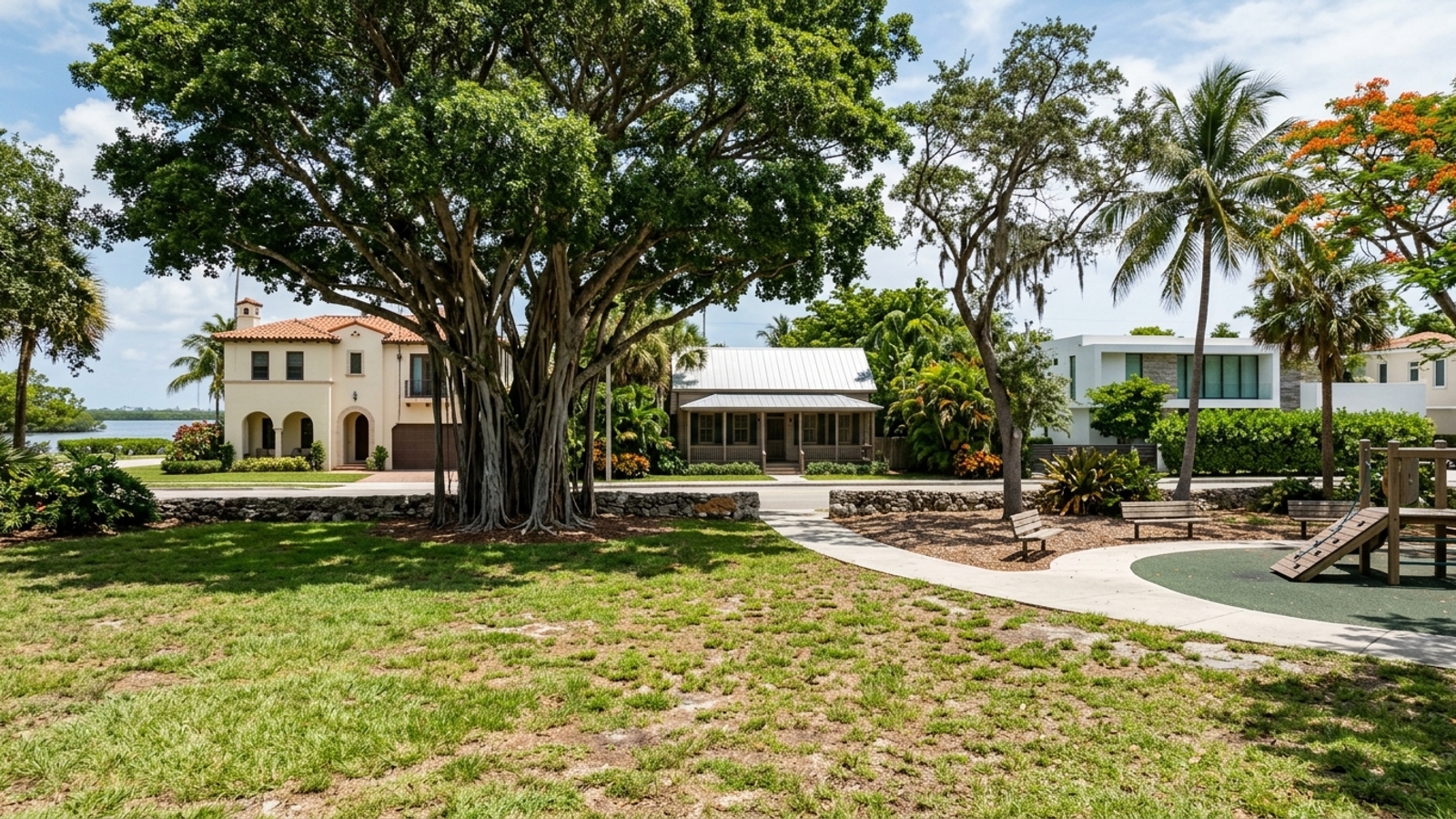
Coconut Grove is a bayfront neighborhood of the City of Miami, about 15 minutes southwest of Downtown. Its main areas are Center Grove, Northeast Coconut Grove, Southwest Coconut Grove, West Grove and Sailboat Bay, plus gated enclaves such as The Moorings and Bay Heights. It sits entirely in Miami-Dade County, and the housing stock reflects a layered history: historic estates, modern condos, gated subdivisions and everything in between. Anyone buying a home in Coconut Grove, FL will find that this architectural variety offers options for almost any lifestyle.
Key Takeaway
The best Coconut Grove neighborhood depends on the trade-off you want:
- Center Grove offers walkable condos and townhomes near CocoWalk.
- Northeast and Southwest Coconut Grove offer detached homes at multimillion-dollar medians.
- Sailboat Bay is the ultra-luxury estate section.
- Gated enclaves rarely have more than a few listings.
Check flood zone and school assignment by address before making an offer.
Who This Guide Is For
Buyers comparing Coconut Grove’s subdistricts and gated enclaves by location, home type and price before they tour.
Coconut Grove Neighborhoods at a Glance
- Overall Grove median about $2.5M (Realtor.com, February 2026).
- Medians: Center Grove $1,948,500; Southwest $2.2M; Northeast $2.3M.
- Metrorail station at US 1 and West 27th Avenue, beside West Grove.
- Bayfront blocks often map AE/VE flood zones; inland mostly Zone X.
- School assignment set by address; Coconut Grove Elementary is on Matilda St.
How Coconut Grove Is Organized
The 2010 census recorded 20,076 people across 5.6 square miles. Main Highway and Grand Avenue are the central corridors running through it.
Gated Enclaves and Subdivisions
The notable gated enclaves are The Moorings, Camp Biscayne, De Garmo Estates, Entrada Estates, Bay Heights and The Cloisters. Private roads, detached single-family homes and limited inventory are the common threads.
These communities sit at the higher end of an already high-priced market. Availability in any given enclave might come down to two or three properties at a time, if that.
Location and Transit Boundaries
Biscayne Bay forms the eastern boundary; LeJeune Road marks the west. US 1, South Dixie Highway, is the main artery for anyone commuting north toward Downtown Miami or heading further south into the county.
The Coconut Grove Metrorail station, at the intersection of South Dixie Highway and West 27th Avenue, gives commuters an alternative to sitting in traffic.
Where Each Neighborhood Sits
The Grove’s layout follows two things: where the water is and where the commercial center lands. Locals generally call the northern, Downtown-side areas North Grove and the southern residential stretch South Grove. Center Grove sits between them.
- Center Grove: The hub, anchored by the CocoWalk and Village Center retail and dining area. Mid-rise condos and townhomes dominate.
- Northeast Coconut Grove: Runs along the bay and pushes toward Downtown Miami, combining waterfront access with a shorter commute north. Part of North Grove.
- Southwest Coconut Grove: Stretches toward the southern city limits. Quieter and mostly residential, with detached homes. Part of South Grove.
- West Grove: Sits inland, closer to US 1 and the Metrorail station.
- Sailboat Bay: Part of the waterfront corridor along Ingraham Highway and the streets leading down toward the Dinner Key marina area. It is made up mainly of large single-family estate homes rather than condos.
Waterfront and Island Sections
Along the bay you’ll find Dinner Key, Peacock Park, Myers Park and the local sailing club. Just offshore to the northeast is Grove Isle, a 20-acre island of high-rise condominiums with direct water views.
Living near the water carries a cost to check. FEMA’s flood maps for Miami-Dade County place coastal and bayfront blocks, including South Bayshore, in the AE and VE Special Flood Hazard Areas. These zones reflect a 1% annual chance of flooding plus wave action. Inland areas farther from the bay are more commonly mapped as lower-risk Zone X.
A home in an AE or VE zone must carry flood insurance if it is financed with a federally backed or federally regulated mortgage. FEMA published preliminary map updates in 2021 that are not yet final, so current maps still set insurance and permit requirements. Confirm any address’s zone on Miami-Dade County’s flood maps before making an offer.
Home Types and Prices Across Coconut Grove
The range here is wide, and the subdistrict matters as much as the house.
- Southwest Coconut Grove: $2.2M median, up 15.0% year over year (Redfin, August 2026).
- Northeast Coconut Grove: $2.3M median, up 28.8% year over year (Redfin, August 2026).
- Overall Grove: around $2.5M (Realtor.com, February 2026).
- Center Grove: about $1,948,500 (Realtor.com, February 2026).
- Sailboat Bay: large single-family estate homes, with reported sales in the tens of millions of dollars.
- West Grove: ask for recent comparable sales on the specific street, since prices shift block by block.
For contrast, the Miami-Dade County single-family median was $699,990 in January 2026, up 3.7% from $675,000 a year earlier, according to the MIAMI Association of Realtors. That countywide figure shows how far most of the Grove sits above the wider market.
Detached Homes and Estates
Single-family homes are the dominant product in South Grove and in gated communities like Bay Heights and Entrada Estates. Larger lots, mature tree canopies and historic architectural details are what you’re buying into.
Before writing an offer, ask for the recent sale-to-list ratio on comparable Grove sales. A ratio close to 100% means well-priced homes leave little room to negotiate. A lower ratio gives you more room to offer under asking.
Condominiums and Attached Housing
Center Grove and the waterfront districts, including Grove Isle, concentrate most of the attached housing. In Center Grove, you trade lot size and quiet for walkability and proximity to retail. That is a reasonable trade depending on what your day-to-day looks like.
City Services in Coconut Grove
The City of Miami Police Department covers the Grove. It assigns a dedicated Coconut Grove neighborhood commander and runs a local substation in the Grove.
Public Schools and School Assignment
Miami-Dade County Public Schools serves the Grove. Coconut Grove Elementary School, at 3351 Matilda St., is the neighborhood elementary. Assignments are address-specific, so before you make an offer, use the district’s boundary lookup to confirm which school your prospective address feeds into.
Finding a Home in Coconut Grove
Coconut Grove is a small slice of the Miami market, so you’re working with a limited pool. Selling speed also differs by home type. One market report citing MLS closings found a median of 32 days on market for single-family houses and 71 days for condos and townhouses in September 2026. Other data providers report anywhere from about 42 to 98 days depending on the period and property type, so treat any single number as a rough guide.
In gated enclaves such as The Moorings or Camp Biscayne, that scarcity is sharper still. An agent who tracks off-market activity in these micro-neighborhoods is worth having. Having financing lined up before an enclave listing appears lets you make an offer as soon as it does.
Preparing Your Search
The gap between subdistrict medians means you should set your budget, and the subdistricts it reaches, before you start touring.
Build the full monthly cost into that budget. The City of Miami’s own operating millage is 7.1080 mills for both 2025 and 2026, per the Miami-Dade County Property Appraiser. Your total tax bill will be higher, because Miami-Dade County, the School Board and special districts add their own rates. HOA fees in the gated enclaves vary, so request them from the seller.
Tour both Center Grove’s CocoWalk corridor and the residential south before narrowing your search, since they feel like different neighborhoods.
Frequently Asked Questions
Do I Need a Permit to Remove a Tree on a Coconut Grove Lot?
Yes, for any tree that meets the city’s size definition. Under Chapter 17 of the City of Miami Code, you need a permit before removing, relocating, root pruning or trimming more than 25% of such a tree. That means a tree at least 12 feet tall with a 2-inch trunk diameter, or a palm at least 16 feet tall with a 6-inch diameter. Trees in the public right-of-way need a separate Public Works permit. If you plan to clear or expand on a lot, confirm the permit requirements before making an offer.
Are Parts of Coconut Grove Under Historic Preservation Rules?
Yes. Two of the City of Miami’s three Neighborhood Conservation Districts are in the Grove:
- NCD-2 covers the Village West Island District and Charles Avenue, roughly Douglas Road to McDonald Street and Abitare Way, and US 1 and Bird Road to Franklin Avenue.
- NCD-3 covers much of the rest of the Grove.
These Miami 21 overlays protect the tree canopy, green space and architectural variety. They add design, massing and lot-coverage standards beyond base zoning. If you plan to renovate or build, confirm which district applies and what it allows before you buy.
How Do You Get to Grove Isle, and Is It Part of Coconut Grove?
Grove Isle is part of the Grove’s waterfront, within the City of Miami. A single bridge off South Bayshore Drive connects it to the mainland. A staffed, 24-hour guarded gate controls access, so the island is closed to through-traffic.
Sources
- Wikipedia: Coconut Grove
- Wikipedia: Grove Isle
- Wikipedia: Coconut Grove Station
- Niche: Coconut Grove Elementary School
- City of Miami Police Department: New Coconut Grove Commander
- Miami-Dade County: Flood Zone Maps
- MIAMI Association of Realtors: January 2026 Miami-Dade Home Sales
- Miami-Dade County Property Appraiser: 2026 Proposed Millage Rate Comparison
- City of Miami: Tree Permit FAQs
- City of Miami: Neighborhood Conservation Districts



