

 Facebook
 X
 Pinterest
 Copy Link
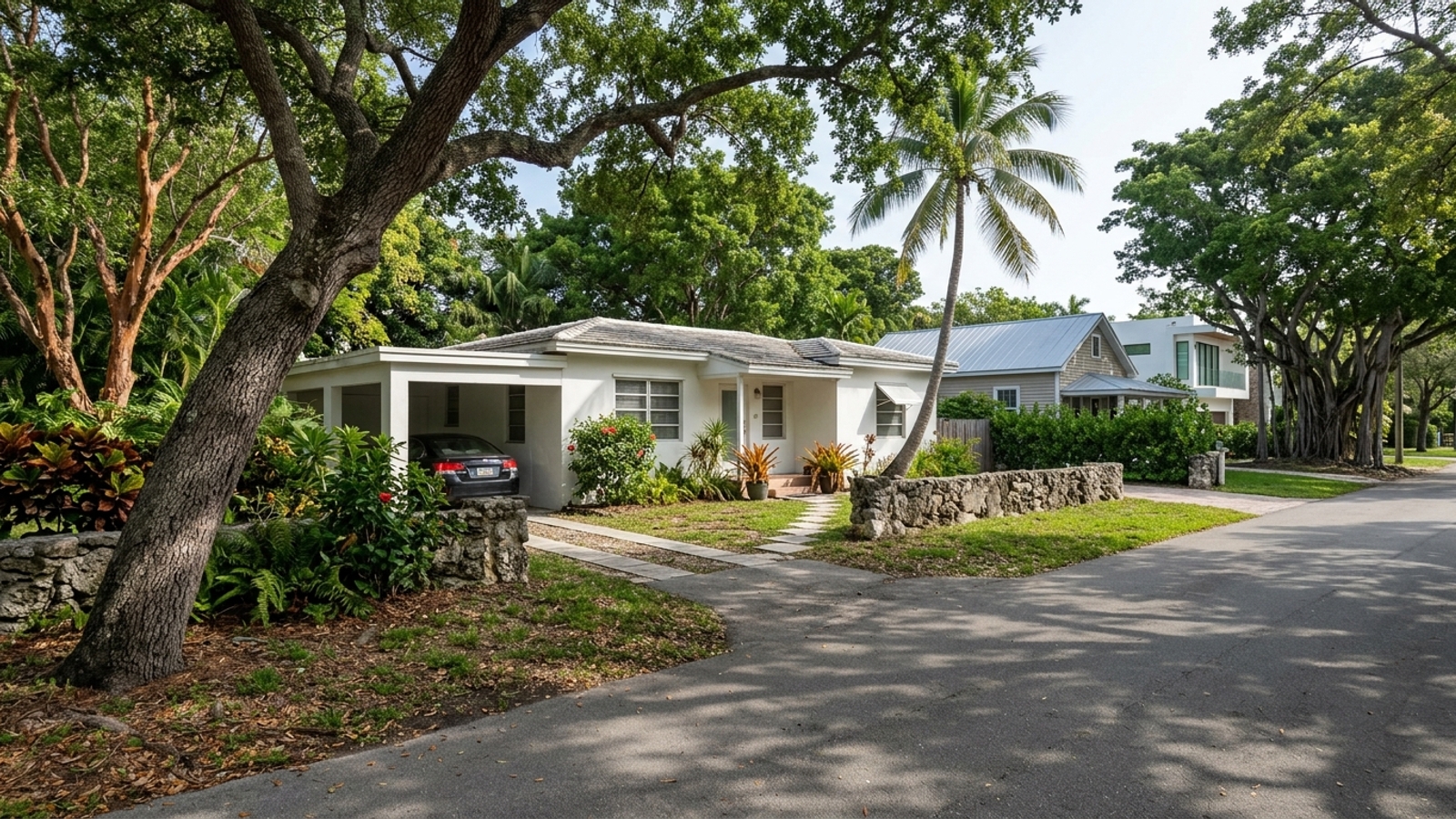
Selling a home in Coconut Grove, Miami, comes down to two paths. You can list on the open market or sell for cash. Buyers judge your home against what else is for sale in the Grove, and the same things that matter to anyone buying a home in Coconut Grove, FL, such as lot, location and condition, set your price on either path.
Key Takeaway
Listing a Coconut Grove home on the open market usually brings the highest price, but marketing time varies by property type, with condos taking longer than houses. A cash sale closes faster and with more certainty, usually at a lower price. Compare the two on what you net after commission and closing costs. Selling as-is does not remove your duty to disclose known defects.
Who This Guide Is For
Owners of a house, townhome or condo in Coconut Grove, Miami, who are weighing whether to list with an agent or take a cash offer.
Selling a Home in Coconut Grove at a Glance
- Median days on market: houses 44, townhomes 50, condos 70; Redfin all-home 133.5.
- Seller costs run about 7% to 8%; commissions average about 5.5%.
- Miami-Dade deed stamps: $0.60 per $100; buyer customarily pays owner’s title policy.
- Financed deals wait on appraisal and loan approval; cash can close in weeks.
- As-is sales still require disclosing known defects and flood history.
What the Coconut Grove Market Looks Like for Sellers
Days on market depend on what you are selling and which tracker you read. Redfin’s neighborhood data show Coconut Grove homes getting about one offer each and selling in around 133.5 days. Another tracker puts the median at 44 days for houses, 50 for townhomes and 70 for condos. The gap comes from property type and reporting period, so a house seller should not plan around the slowest figure.
Supply also differs by property type. As of September 2026, Miami-Dade carried 5.1 months of supply for single-family homes, down from 6.5 a year earlier, and 12.3 months for existing condos and townhouses, according to MIAMI REALTORS. A balanced market is six to nine months. Single-family sellers face less competition than that range. Condo sellers face more, so price and condition matter more for condos.
Selling With a Listing Agent
The open-market path runs in this order:
- Pricing: The agent prices the home from recent comparable sales in the Grove.
- Preparation: Light prep, cleaning and professional photos.
- Listing and showings: The home goes on the MLS, where every active buyer and agent can see it.
- Offers: You review offers.
- Inspection and financing: The buyer inspects. A financed buyer also needs an appraisal and loan approval after you accept the offer.
- Closing: A title company handles the deed, payoff and funds.
The main risk you carry on this path is a financed deal falling apart late. If the appraisal comes in below the price or the lender’s underwriting stalls, the buyer may renegotiate or walk away, and you go back on the market.
Selling to a Cash Buyer
Cash comes from three kinds of buyers: investors, iBuyer-style companies that make instant offers, and ordinary buyers who find your home through a listing. Cash is common locally. Cash sales were 38.3% of all Miami-Dade closings in September 2026, including 49.4% of existing condo sales and 26.2% of single-family sales, against roughly 27 percent nationally, per MIAMI REALTORS and NAR. That means a listed home can still draw cash buyers without giving up open-market competition.
The real advantage of cash is certainty. With no appraisal and no loan underwriting, fewer deals fall through.
A direct cash offer from an investor usually sits below what the open market would pay.
How the Process Works
It starts with an evaluation of your property. The buyer looks at the home’s condition, the lot size, and recent comparable sales in your immediate neighborhood to land on a number. You don’t need to clean, stage, or photograph anything for this step.
From there, you receive a written offer with no obligation to accept. Set that number against an agent’s open-market price for your home, minus selling costs.
Choosing Your Closing Date
A cash sale lets you set the closing date. If you need to move fast, for example for a job relocation, a cash transaction can often close in as little as a week or two, depending on how quickly title can be cleared.
If you need more time to pack up or find your next place, you can schedule closing a month or more out.
Comparing What You Net: Listing vs. Cash in Miami-Dade
Compare what you take home, not the headline price. Use these Miami-Dade figures:
- Total seller costs: Florida sellers pay on average 7% to 8% of the sale price, assuming a 6% commission and that the seller pays title insurance and search fees.
- Deed stamp tax: Miami-Dade charges $0.60 per $100 on the deed, plus a surtax on non-single-family property. On a $1,000,000 sale, that is $6,000.
- Owner’s title policy: In Miami-Dade, the custom is that the buyer pays for it, unlike most Florida counties.
On the listing side, add any repairs a buyer asks for. Also add the mortgage, property tax and insurance payments you keep making while the home is on the market. On the cash side, the price is lower, but those carrying costs and the commission mostly drop away. Put both paths on one net sheet before you decide.
Selling As-Is Without Repairs
A traditional listing often comes with a repair list. Buyers using FHA or VA financing must meet property condition standards, and their lenders will decline the loan if the house falls short, so a financed buyer may force repairs. You can avoid that by selling to an investor, or by listing as-is with an agent and inviting cash and conventional buyers.
As-is does not remove your legal duty to disclose. Under Johnson v. Davis, 480 So. 2d 625 (Fla. 1985), Florida sellers must disclose known facts that materially affect value and are not readily observable to the buyer. In Rayner v. Wise Realty, Florida’s First District Court of Appeal held that this duty applies to as-is sales: an as-is clause limits the buyer’s right to demand repairs, not your duty to avoid concealing known defects.
Florida Statutes section 689.302 also requires a written flood disclosure at or before the time the contract is signed. Since October 1, 2025, it covers:
- any flood insurance claim
- any flood assistance received
- any flooding you know damaged the property while you owned it, even without a claim
Skipping disclosure exposes you to a claim from the buyer after closing.
Extra Steps for Condo Sellers
Condo buyers look hard at the building. Under Florida Statute 553.899, condo buildings three or more habitable stories tall need a milestone inspection. It is generally due by the end of the year the building turns 30 (25 in some coastal jurisdictions), then every 10 years after. Under Florida Statute 718.112(2)(g), associations must complete a structural integrity reserve study at least every 10 years for those buildings. The reserves it identifies cannot be waived for budgets adopted on or after December 31, 2024.
Under Florida Statute 718.503, you must give the buyer:
- the declaration, articles, bylaws and rules
- the latest year-end financial statement and budget
- the milestone inspection summary, if applicable
- the most recent reserve study, or a statement that none was done
- the turnover inspection report
The buyer has a statutory right to cancel. Pending special assessments for inspection or reserve work are a cost buyers and their lenders will weigh. The association supplies these documents, so contact your association manager early.
Typical Fees and Commissions
Commissions are negotiable. The statewide average is about 5.5%, with 5% to 6% the commonly cited range. Settle with your listing agent, before you list, whether you will offer to pay any part of the buyer’s agent’s fee.
If a direct cash buyer says they will pay your closing costs, get that written into the purchase contract.
Timeline Differences
On the listing path, the total time is the days on market for your property type plus the financing period after you accept an offer. On the cash path, it is the closing window you choose. The difference is largest for condos and smallest for well-priced houses.
How Location Within the Grove Affects Your Price
Pricing differs across North, Center and South Grove. The drivers are about the property itself:
- lot size
- distance to Biscayne Bay
- waterfront versus inland
- the age and style of the home
- tree canopy
On an older house that needs work, the land underneath often carries much of the value.
Historic status also shapes what a buyer can do. Coconut Grove falls under the City of Miami’s Historic and Environmental Preservation Board. The city has designated Coconut Grove Village West as a historic district. Individual sites such as the Coconut Grove Playhouse, the Coconut Grove Library and the First Coconut Grove School are separately recognized.
If a property is individually designated or sits in a designated district, most exterior changes, new construction or demolition need a Certificate of Appropriateness before a building permit can issue. Minor work uses a standard certificate. New construction, demolition or large alterations need a special certificate reviewed by the board.
Confirm your home’s status with the City of Miami’s historic preservation staff before listing. It affects what a buyer can rebuild, and so what they will pay.
What Buyers Check in 33133
Buyers in 33133 look into a few things before they make an offer:
- Flood zone and insurance: Look up your FEMA flood zone and have an elevation certificate ready, since flood insurance cost affects what a buyer can afford.
- Roof and windstorm features: Roof age and features such as impact windows drive insurance quotes.
- Permit history: Buyers want to see that past work was permitted and closed.
Getting a Price for Your Coconut Grove Home
Get two numbers to compare. The first is an agent’s comparative market analysis built on recent Grove sales of homes like yours. The second, if you want one, is a written cash offer. Neither commits you to anything.
What to Have Ready
These items speed up pricing and the sale on either path:
- Ownership and loan: The deed and your mortgage payoff information.
- Permits: Your permit history, including any open or expired permits.
- Insurance: Roof age and current insurance details.
- Survey and elevation: The survey and elevation certificate, if you have them.
- Condo contact: For condos, the association manager’s contact information.
Be straightforward about any significant defects, such as a failing roof or foundation issues. Accurate information upfront gets you a realistic number faster.
What to Expect After You Reach Out
Both paths start with a walk-through of the home. On the listing path, a pricing discussion and a listing agreement follow. On the cash path, you receive a written offer and, if you accept, a purchase contract. Either way, you close on the date you agreed.
Frequently Asked Questions
How Fast Can I Sell My House in Coconut Grove?
Recent medians are 44 days on market for houses and 70 for condos, plus appraisal and loan time if the buyer finances. A cash sale closes on the date you choose once title is cleared.
Can I Sell My House As-Is in Coconut Grove?
Yes, either to a cash buyer or through a listing marketed as-is. You must still disclose known material defects and give the written flood disclosure.
How Do Cash Home Buyers in Coconut Grove Determine Their Offer?
They start from recent comparable sales in the Grove, then subtract estimated repairs, holding and resale costs, and their profit.
Are There Any Fees to Sell My House Fast in Coconut Grove?
Yes. A direct cash sale drops the commission, but closing costs such as the deed stamp tax still apply, and the lower price usually absorbs the savings.
Should I Sell to a Cash Home Buyer or List My Property on the Traditional Miami-Dade Market?
List when your home shows well and you can wait out the marketing time for your property type. Take cash when speed or certainty matters more than top price, or when your home won’t meet lender standards.
What Happens If My Coconut Grove Home Has Hurricane Damage or Open Permits?
You can still sell on either path, but known damage must be disclosed. Open permits will show up in the title company’s search. You either close them with the City of Miami building department or price them into the deal. An open insurance claim should be resolved or addressed in the contract.
Do I Owe Capital Gains Tax When I Sell My Coconut Grove Home?
Under Section 121, you can exclude up to $250,000 of gain from federal tax if single, or $500,000 if married filing jointly. To qualify, you must have owned the home and lived in it as your main residence for at least two of the five years before the sale. Joint filers need only one spouse to meet the ownership test, but both must meet the use test, and neither can have used the exclusion within the prior two years. Florida has no state personal income tax, so no state tax applies to the gain. For gains above the exclusion, talk to a tax professional.
Can I Keep My Homestead Property Tax Savings When I Move to Another Florida Home?
Yes, through Save Our Homes portability, which lets you transfer up to $500,000 of your accumulated assessment difference to a new Florida homestead. You must have had a homestead exemption as of January 1 in any of the three preceding years. File the new homestead and portability application with the property appraiser of the new home’s county by March 1 of the year you claim the new exemption.
I Live Outside the U.S.: Is Money Withheld When I Sell?
Yes. When a foreign person sells U.S. real property, the buyer must generally withhold 15% of the amount realized for federal tax. No withholding is required if the amount realized is $300,000 or less and the buyer will use the home as a residence. The title company handles the withholding at closing, and you can apply to the IRS to reduce it.
Can I Sell If I Still Have a Mortgage on the Home?
Yes. The title company orders a payoff statement from your lender and pays off the loan from the sale proceeds at closing, and you receive the rest. If the price won’t cover the payoff, you need the lender’s approval for a short sale.
Sources
- Coconut Grove Housing Market, Redfin neighborhood data
- Miami Seller Closing Cost Calculator, Hauseit
- Miami-Dade Market Report, October 16, 2026, MIAMI REALTORS
- Florida Real Estate Disclosure Requirements
- Florida Statutes Section 689.302, Flood Disclosure
- Florida Statutes Section 718.112
- Get a Standard Certificate of Appropriateness, City of Miami
- Home Sale Capital Gains Exclusion 2026 Guide
- Florida Statutes Section 193.155 (2024)
- FIRPTA Withholding, IRS



